

Exact checkpoint
This page follows the original TensorFlow implementation and its Semantic3D task. The authors link a pretrained-model collection; select the Semantic3D checkpoint inside it. GISSchools does not host or claim to have executed that checkpoint.
How it works
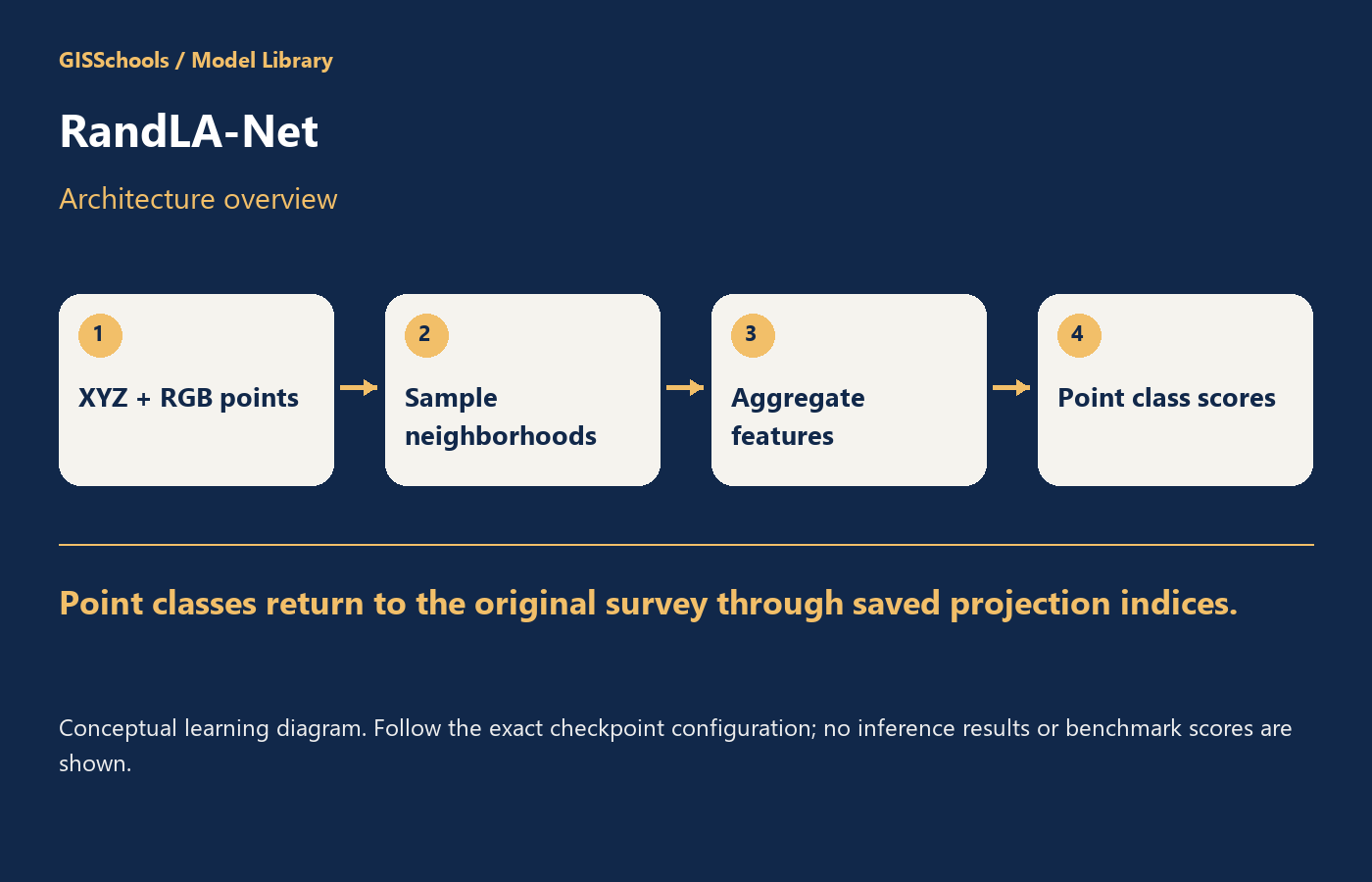
The network reduces the number of points through random sampling while combining neighboring geometric information. A decoder brings learned features back toward point-level semantic predictions.
Typical input and output
The Semantic3D loader uses XYZ geometry and RGB features with prepared neighborhoods and projection indices. Its label map separates built and natural terrain, high and low vegetation, buildings, hardscape, scanning artifacts and cars; unlabeled points are ignored. Keep the original point ordering when projecting predictions back.
Strengths
A useful point-based reference for comparing local neighborhood processing with a superpoint-based model. It makes the sampling and feature-preparation stages visible to learners.
GIS and remote-sensing use
Start with outdoor survey interpretation: review vegetation, building and terrain candidates. A Semantic3D terrestrial-scanning model needs local validation before it is applied to aerial LiDAR, mobile scans or photogrammetric clouds.
Limitations
Missing RGB, different density, occlusion and unfamiliar structures can change results. Semantic vegetation labels do not identify individual trees or species. This page supplies guidance and official resources, not a browser inference service.
Training and fine-tuning
Use the repository preprocessing script for Semantic3D, then its main_Semantic3D.py training entry point. For custom labels, adapt the dataset loader, label map and classifier together. Keep spatially separate validation clouds and compare per-class IoU, confusion patterns and boundary errors.
Framework and hardware
The official setup is a legacy TensorFlow 1.x and CUDA environment with compiled operations. Reproduce its documented environment in isolation; do not assume a current TensorFlow installation is compatible. Memory requirements depend heavily on cloud preparation and sampling.
Files, license and download
Official weights remain external in the authors' Google Drive collection. The repository declares CC BY-NC-SA 4.0: non-commercial use, attribution and share-alike conditions apply. Check any checkpoint-specific notices and dataset terms before reuse. No weight bytes were mirrored or tested here.
Before using a result
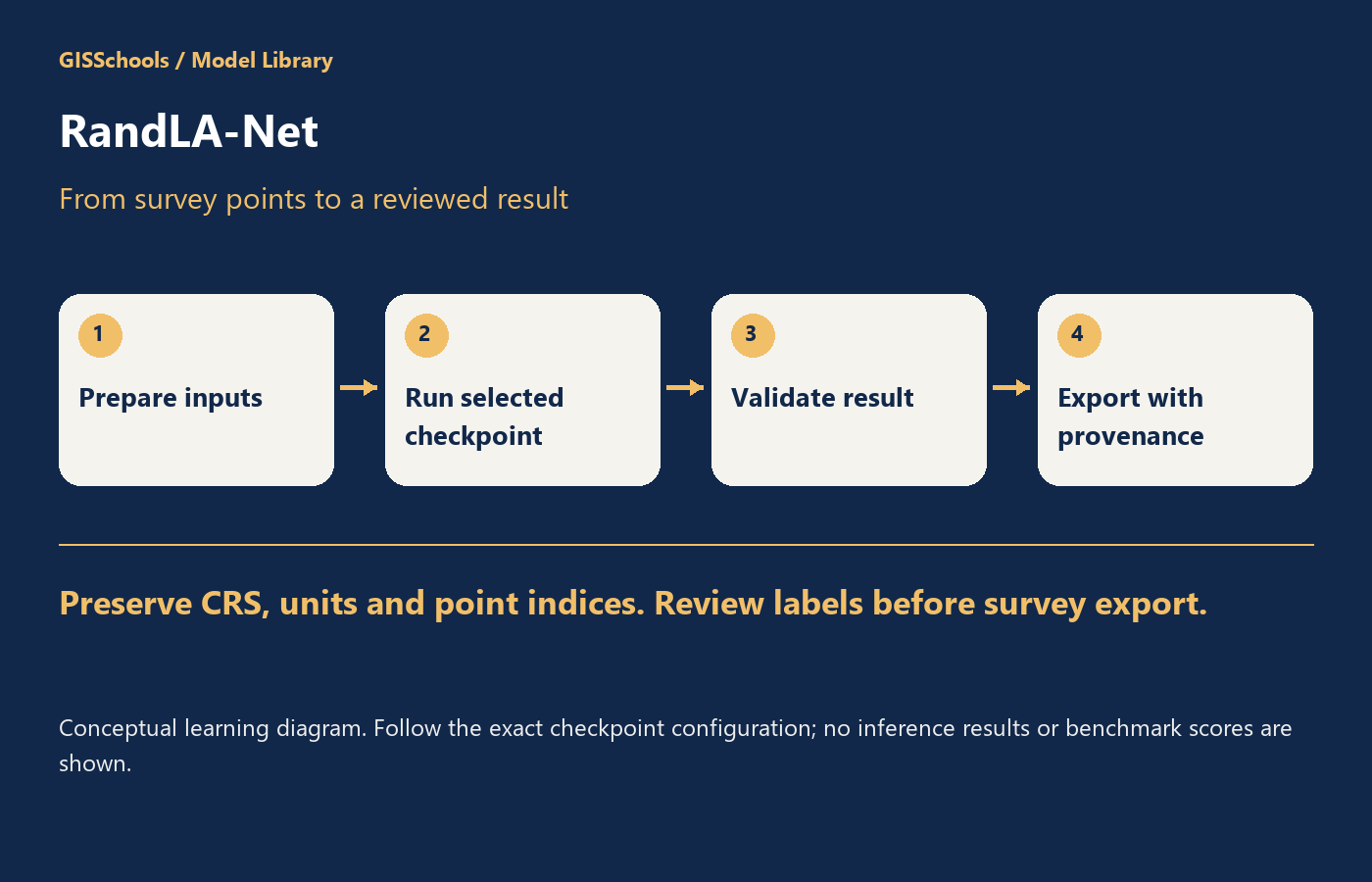
- Keep survey rights, acquisition dates and preprocessing with each experiment.
- Separate locations before tiling to avoid train/test leakage.
- Inspect failures and uncertain outputs alongside the original point cloud.
- Preserve coordinate transforms and verify units before exporting a GIS layer.
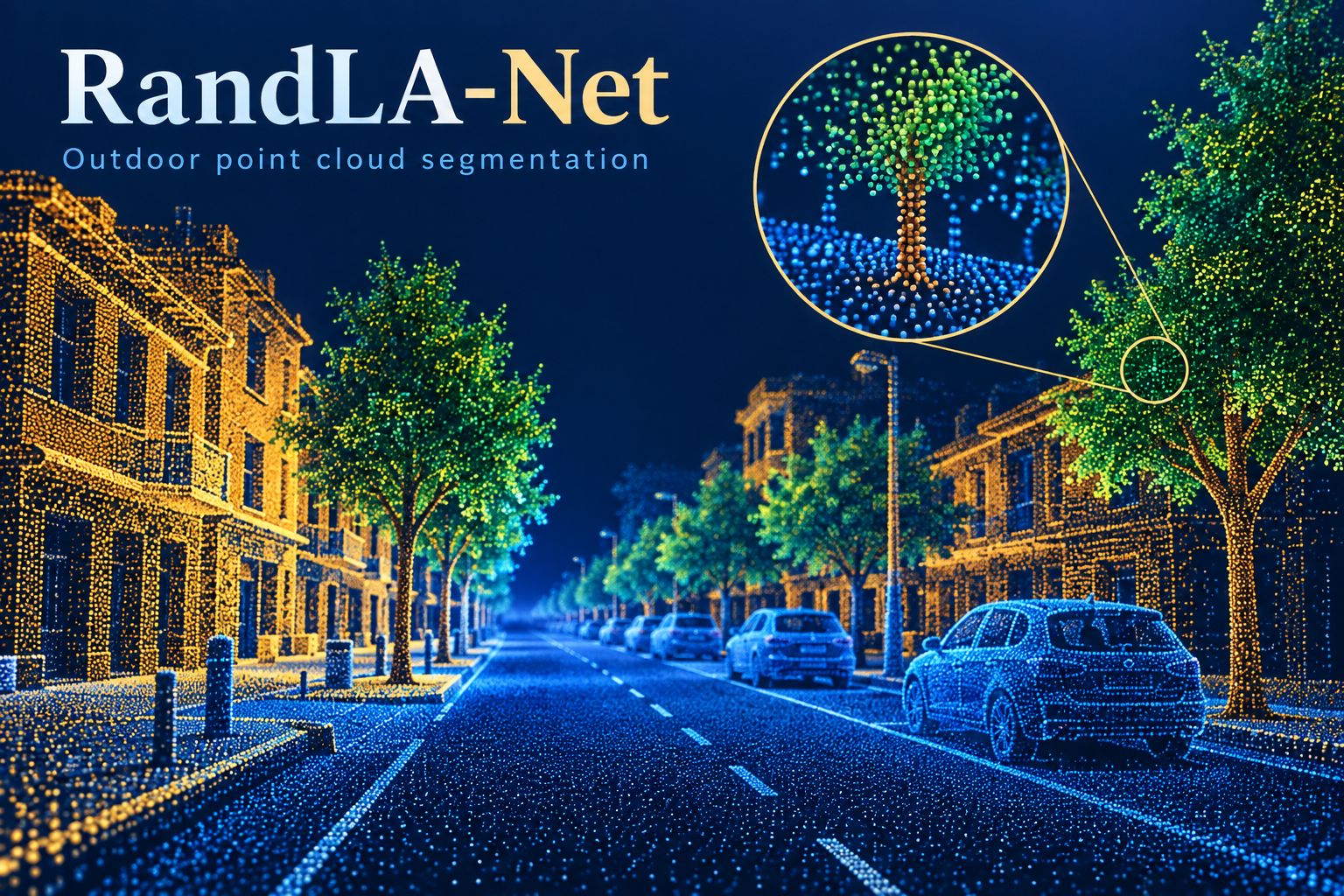
Validation status: Source provenance and website delivery are checked. GISSchools has not run model inference, training or an accuracy benchmark for this record. Feature images and gallery diagrams are explanatory illustrations, not predictions.
Official references
Examples and images
Downloads and resources
Official weights remain external in the authors' Google Drive collection. The repository declares CC BY-NC-SA 4.0: non-commercial use, attribution and share-alike conditions apply. Check any checkpoint-specific notices and dataset terms before reuse. No weight bytes were mirrored or tested here.
Comments
No comments yet. Start the discussion.
Leave a reply
Your email address will not be published. Required fields are marked.