
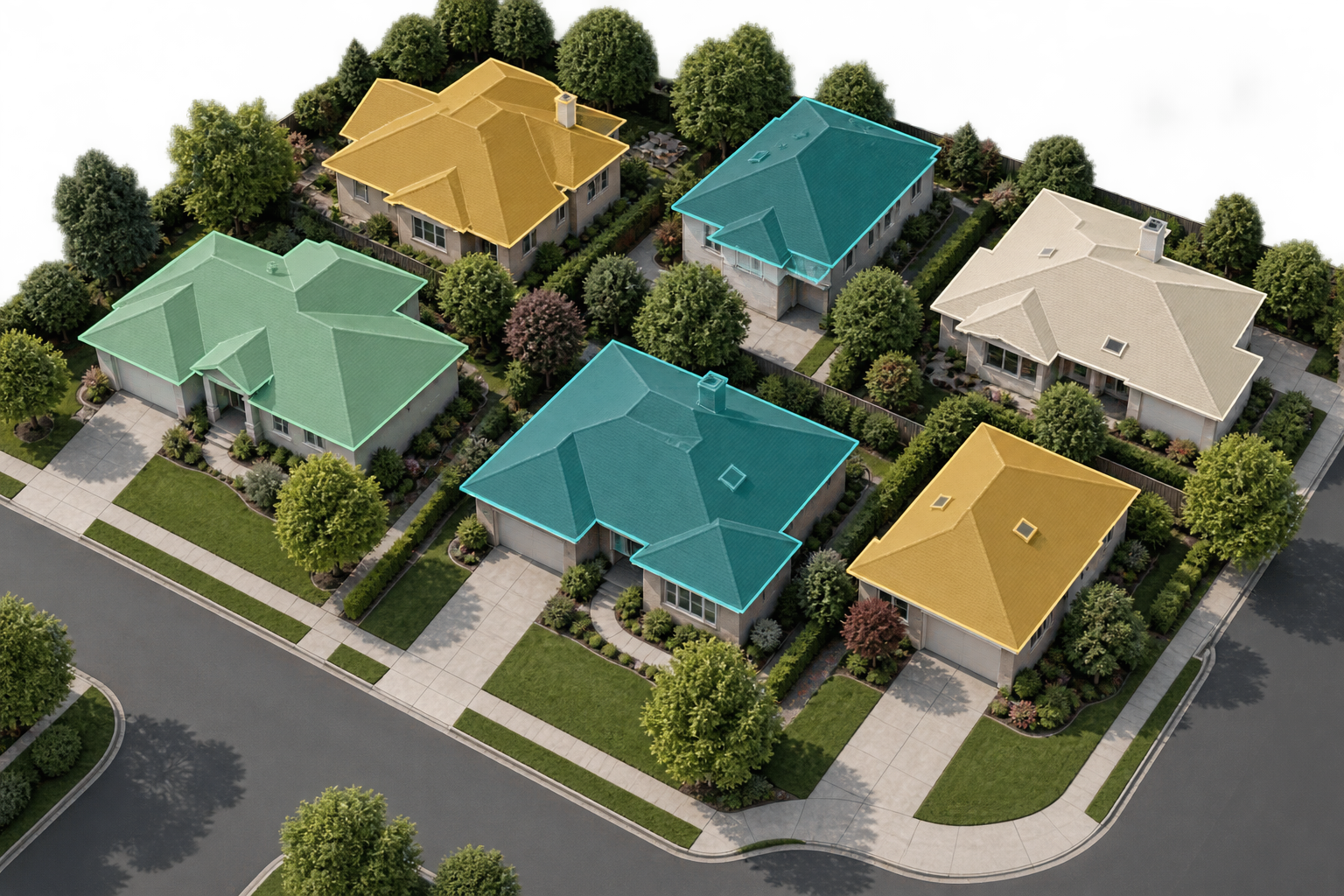
What is instance segmentation?
Instance segmentation combines object recognition with a separate pixel mask per object. Two buildings can have the same class but different instance identifiers. It is useful when both geometry and object counts matter.
Inputs and outputs
| Input | Output |
|---|---|
| Image tiles with an individual mask or polygon and class for each annotated object. | Separate object masks, labels and scores that can support reviewed GIS polygons. |
Where it helps in GIS
Delineate building footprints or individual tree crowns. Agree on labeling rules for touching, truncated and partly obscured objects.
Model families and examples
- Mask R-CNN: extends Faster R-CNN with an object-mask prediction branch.
- YOLO segmentation variants: another instance-mask workflow; check that the checkpoint supports segmentation.
These examples explain the task. The sidebar shows only models currently published on GISSchools.
How to start training
Label each instance separately and check polygon quality. Keep test areas geographically independent. Fine-tune, review merged or split objects, and test different object densities before converting predictions into vector features.
How to judge the result
Check mask average precision and object-level mistakes. Roof boundaries may differ from ground footprints. Shadows, overlapping crowns and tiny objects can make reference boundaries ambiguous.
Learn more
The category image is an illustration, not an evaluated model prediction.