

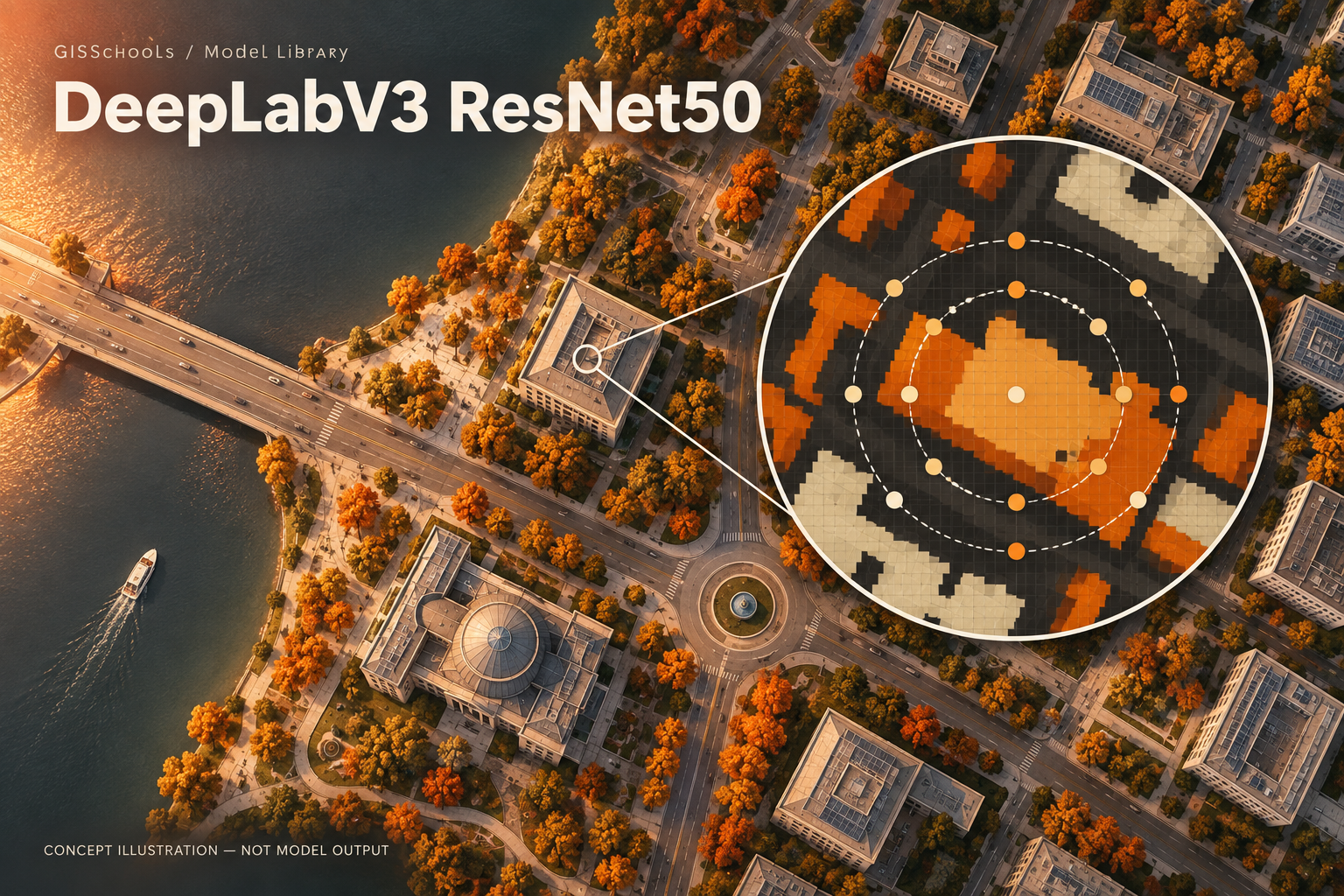
Exact checkpoint
The exact TorchVision weight enum is DeepLabV3_ResNet50_Weights.COCO_WITH_VOC_LABELS_V1. The official file is deeplabv3_resnet50_coco-cd0a2569.pth. The weight recipe uses COCO samples with the 20 Pascal VOC foreground categories plus background. It is DeepLabV3, not DeepLabV3+.
How it works
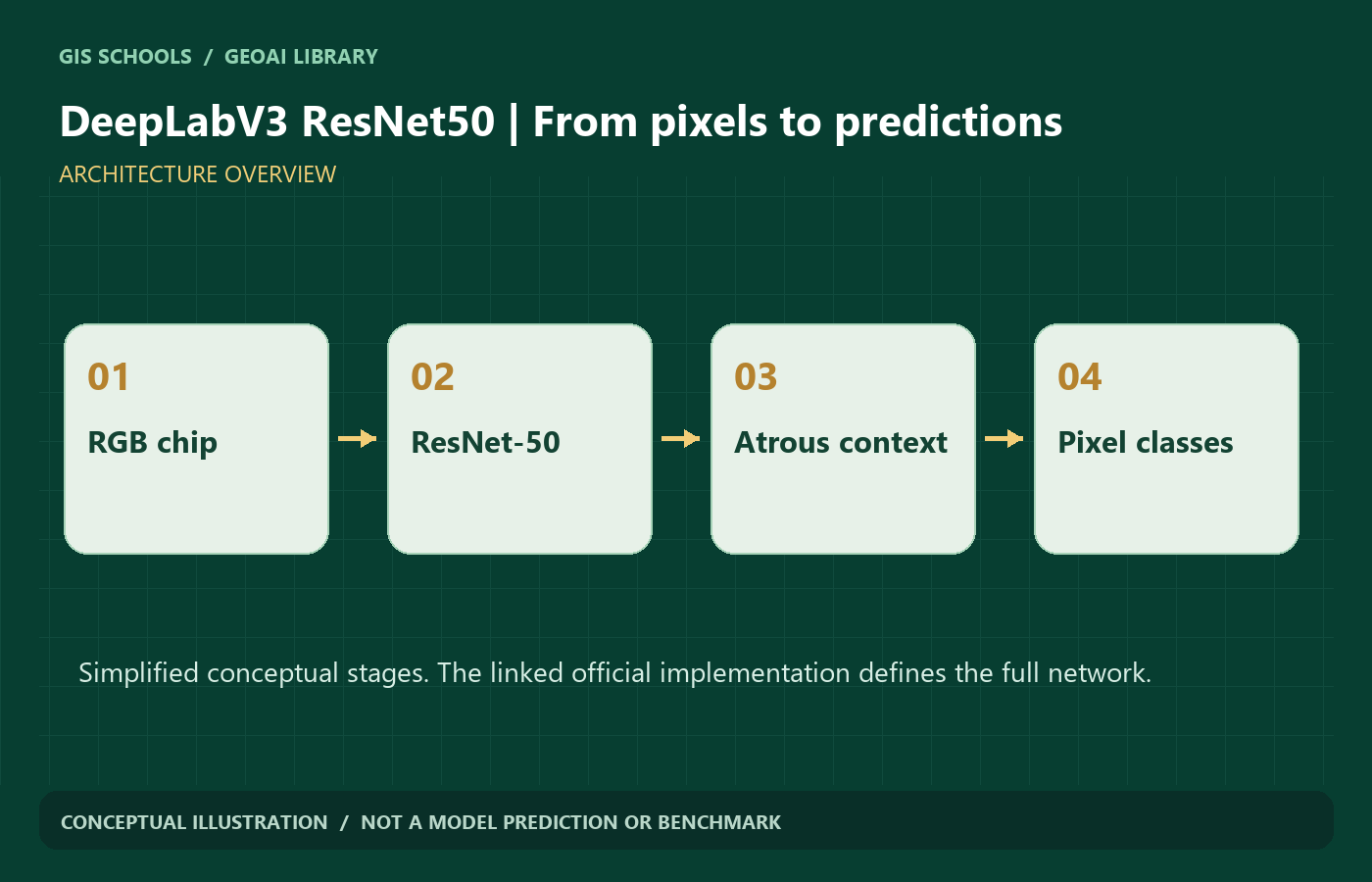
A ResNet-50 backbone extracts features while atrous convolution samples a wider area without simply shrinking every feature map. Atrous spatial pyramid pooling combines several context scales. A semantic classifier produces dense class scores; these are upsampled for pixel labeling. The original DeepLabV3 paper explains the context module, while TorchVision defines this particular implementation and checkpoint.
Typical input and output
Input: RGB image converted using weights.transforms(). The documented inference transform resizes the shorter edge to 520 pixels and applies the checkpoint normalization. Output: the out tensor contains semantic logits; selecting the largest class score at each pixel produces a label map. Preserve background and class order.
Why consider this model
This is an established convolutional baseline with a standard TorchVision loading interface. Multi-scale atrous context is useful for investigating how surrounding image structure influences a pixel prediction. It offers a different design from the hierarchical Transformer in SegFormer.
GIS and remote-sensing workflow
After suitable fine-tuning, semantic segmentation can support building, road, vegetation, water or construction-area mapping. These are target applications, not verified capabilities of the supplied weights. Keep masks on a known raster grid, restore the original spatial transform, and check class semantics before polygonizing. A pixel mask alone is not a surveyed boundary.
Limitations
Pascal VOC labels are not a GIS land-cover legend: these weights do not provide a ready-made road, water or building map. Semantic masks do not separate adjacent instances. Coarse features and resampling can blur narrow objects. Check data and weight usage conditions separately from the repository code license.
Training and fine-tuning
Prepare aligned RGB chips and integer semantic masks. Replace the main classifier for the target class count and configure the auxiliary classifier consistently if used during training. Use a compatible loss with explicit ignored pixels and fine-tune with a documented optimizer and validation split. Confirm that the new head, label IDs and preprocessing agree before training at scale.
Framework and hardware
PyTorch and TorchVision. Load the named weights enum through deeplabv3_resnet50 and use the associated transforms. Run inference in evaluation mode with gradients disabled. CPU can establish correctness on a few images; GPU training is generally more practical. Batch size and chip dimensions determine memory needs; no fixed VRAM claim is made.
Model files and license
Official external download only. TorchVision explicitly states that pretrained models may carry their own terms derived from training data. The BSD-3-Clause code license alone is not sufficient evidence for unrestricted redistribution of this checkpoint, so GISSchools has not mirrored it.
Practical validation before mapping
- Split by geographic area before creating overlapping chips; keep the final test area out of model selection.
- Inspect different seasons, shadows, sensors and object sizes. Review errors on the original imagery, not only a single aggregate score.
- Use per-class IoU, confusion matrices and boundary inspection. Keep uncertain outputs for human review.
- Record data rights, coordinate reference system, pixel size, preprocessing and model revision with exported results.
Validation status: GISSchools has checked source provenance and website delivery. No training, inference benchmark or remote-sensing accuracy evaluation was performed for these pages. Gallery diagrams are conceptual illustrations, not model predictions.
Official references
Examples and images

Downloads and resources
Official external download only. TorchVision explicitly states that pretrained models may carry their own terms derived from training data. The BSD-3-Clause code license alone is not sufficient evidence for unrestricted redistribution of this checkpoint, so GISSchools has not mirrored it.
Original implementation and project updates.
Loading, preprocessing and usage reference.
Review the terms before using or redistributing the model.
Comments
No comments yet. Start the discussion.
Leave a reply
Your email address will not be published. Required fields are marked.