

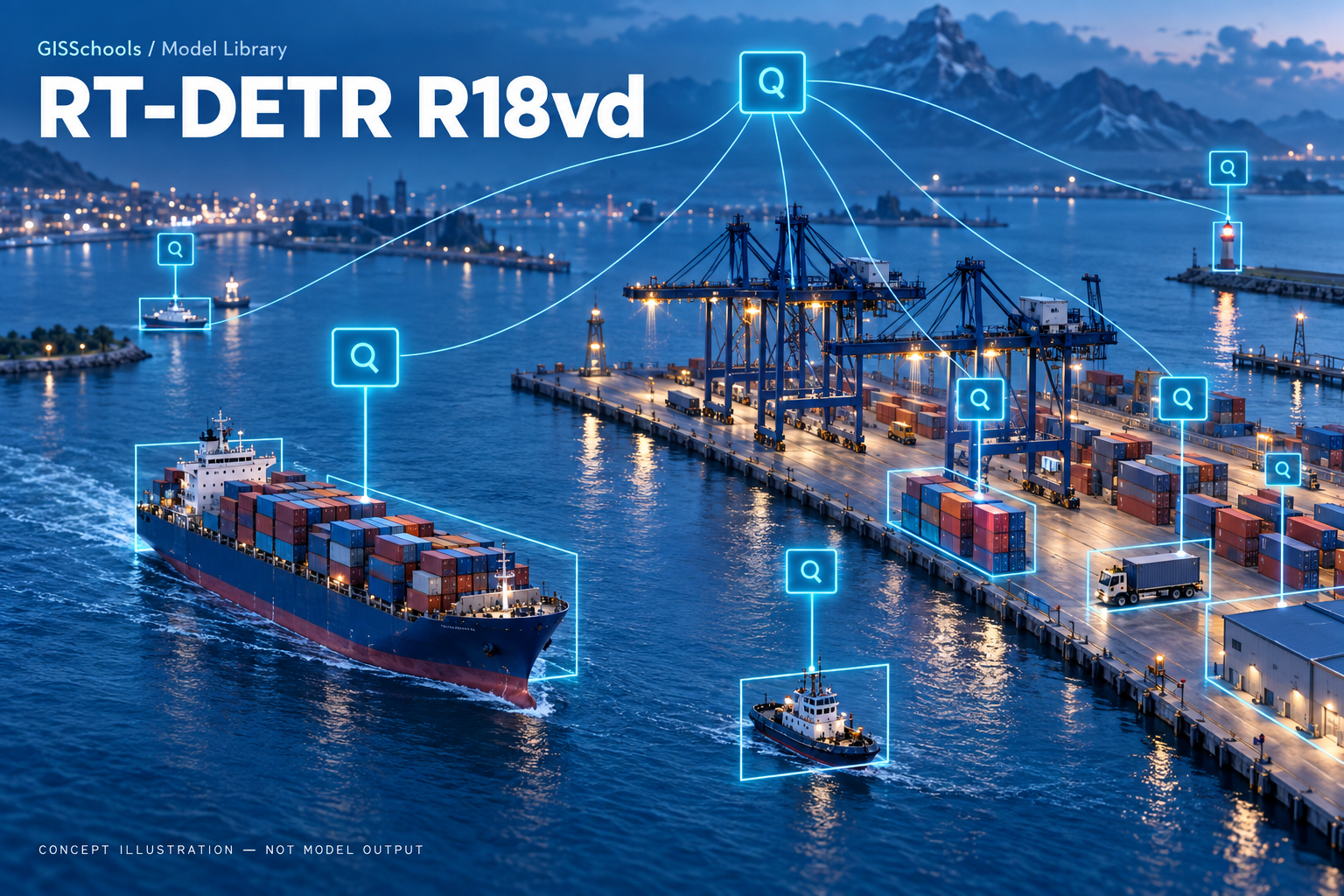
Exact checkpoint
This is the PekingU/rtdetr_r18vd Transformers checkpoint at immutable revision ac77a11ff0170a41b771c03264987f8ce2b0d753. It is the COCO-trained R18vd variant of the original RT-DETR family; it is not RT-DETRv2 or the larger R50 variant. The unmodified model.safetensors is 80,904,152 bytes.
How it works
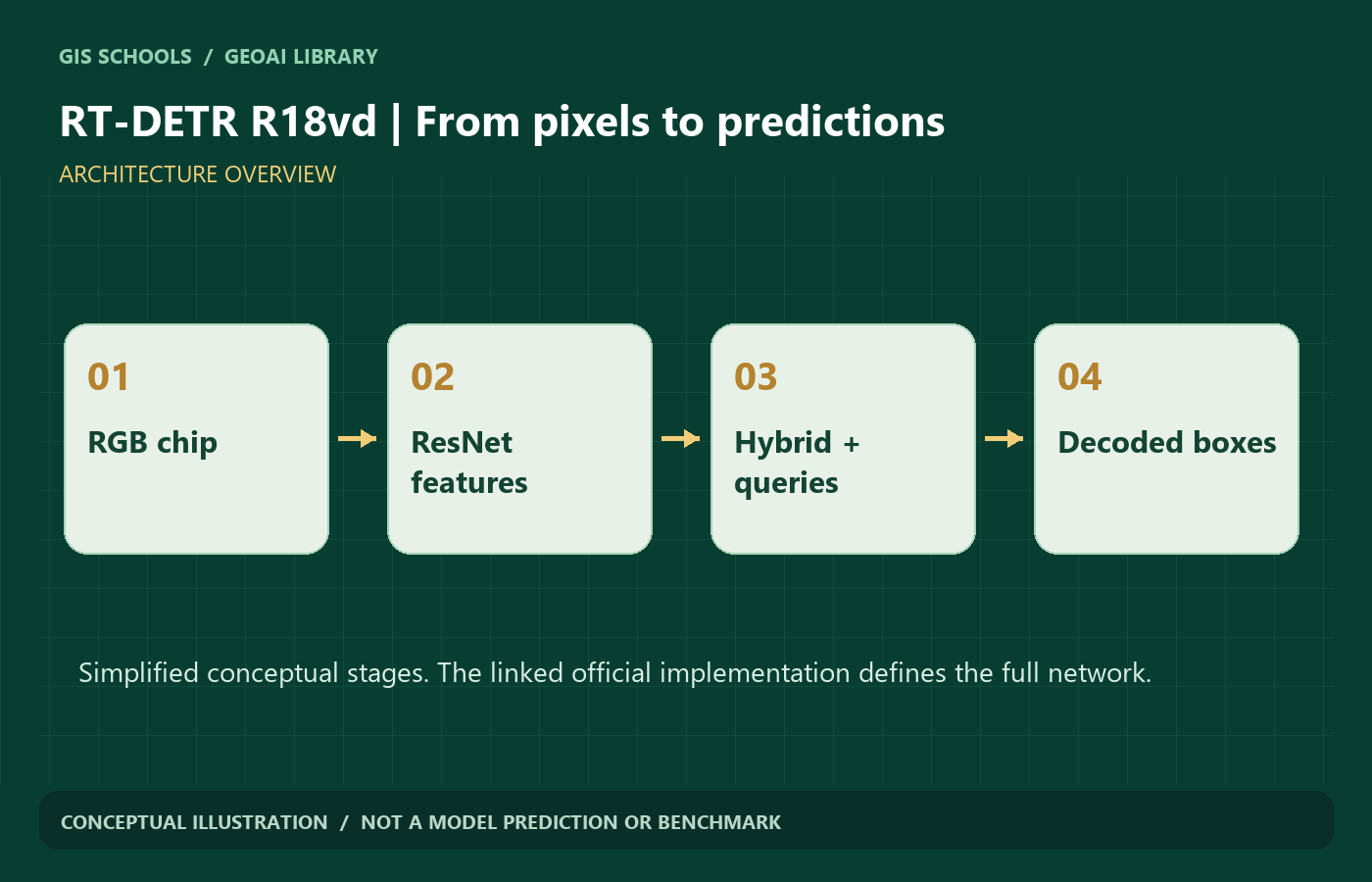
A ResNet backbone builds a feature pyramid. A hybrid encoder combines local image structure with attention-based context, then selected queries enter a Transformer decoder. The decoder refines a set of object boxes and labels. This gives a useful architectural contrast to a convolutional YOLO detection head. The RT-DETR design is end-to-end and avoids a separate NMS stage.
Typical input and output
Input: RGB imagery processed by the checkpoint image processor. The pinned preprocessor_config.json specifies height 640 and width 640, rescaling enabled and normalization disabled. Use this saved processor rather than manually adding normalization from a generic example. Output: box coordinates, labels and scores after post-processing to the source image dimensions.
Why consider this model
The official Transformers packaging keeps model configuration, image processing and class mapping together. Query-based prediction is useful for comparing detector designs under the same aerial validation split. The R18 backbone offers a smaller option within RT-DETR.
GIS and remote-sensing workflow
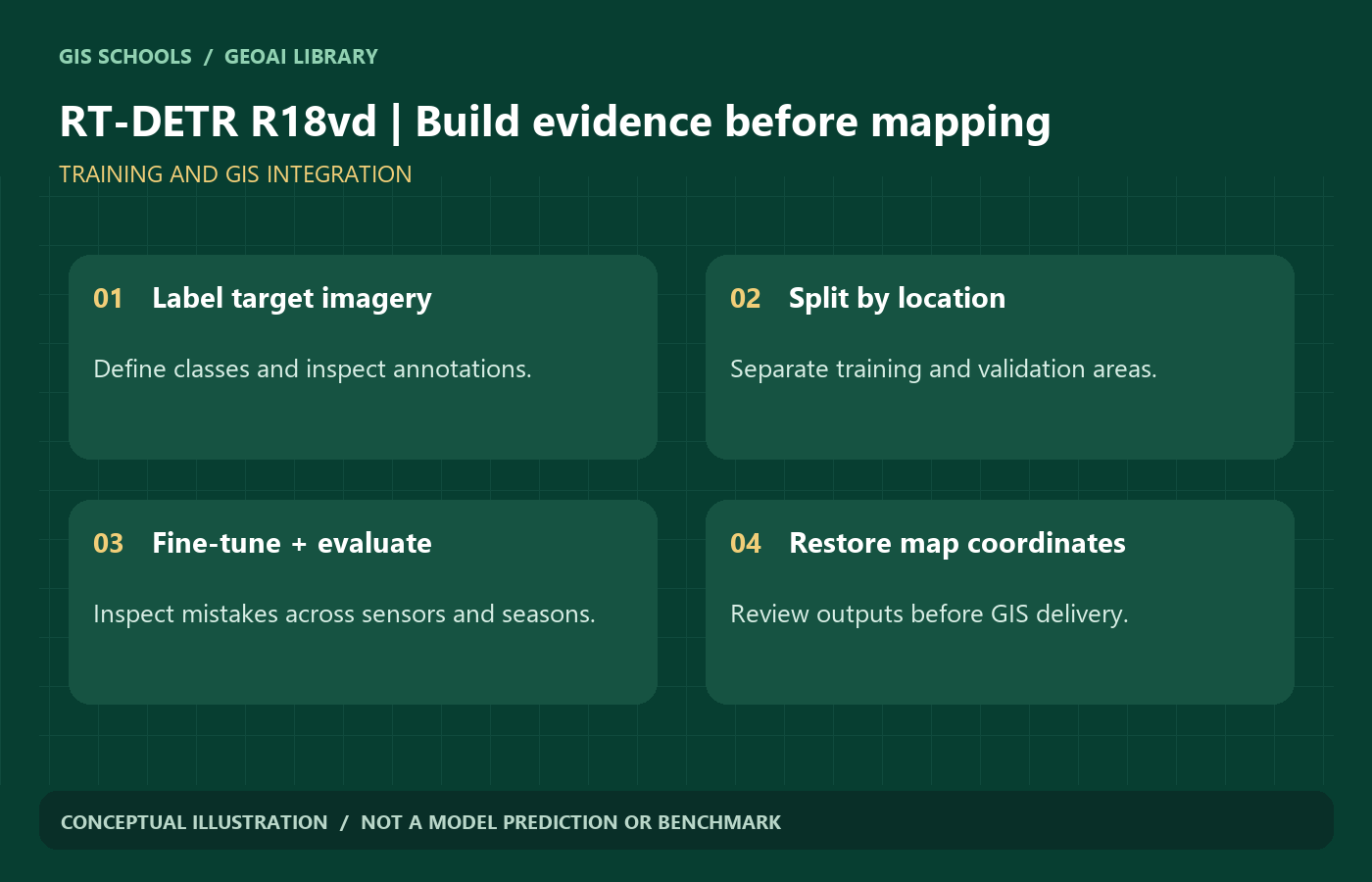
After task-specific fine-tuning, detection can support inventories of buildings, vehicles, trees, solar installations or infrastructure assets. These are potential project targets, not a claim about the supplied checkpoint. Preserve each chip origin and resolution, transform image boxes back to map coordinates, and review overlaps before building an asset inventory.
Limitations
COCO training does not establish aerial building, tree or solar-panel accuracy. Query predictions still need validation and threshold selection. Crowded objects, tile edges and geographic domain changes can affect results. Transformer design alone does not make a model GIS-aware.
Training and fine-tuning
Use the official repository training configuration or a compatible Transformers training workflow. Supply image/box/class annotations, adapt the prediction head and label mapping for new classes, and retain the checkpoint preprocessing configuration. Begin with a small training and validation run to confirm annotation conversion and loss behavior before a larger job.
Framework and hardware
PyTorch with Hugging Face Transformers. Extract the supplied ZIP and load the local rtdetr_r18vd directory with RTDetrImageProcessor.from_pretrained(path) and RTDetrForObjectDetection.from_pretrained(path). CPU is suitable for a functional trial; an appropriate GPU is recommended for iterative training. No GISSchools speed or VRAM benchmark has been run.
Model files and license
Locally hosted: unmodified official safetensors, config, processor and model card, with the complete Apache-2.0 license and a GISSchools provenance file. The model card explicitly declares Apache-2.0; attribution and original filenames are retained. The ZIP is packaging only, not converted or newly trained weights.
Practical validation before mapping
- Split by geographic area before creating overlapping chips; keep the final test area out of model selection.
- Inspect different seasons, shadows, sensors and object sizes. Review errors on the original imagery, not only a single aggregate score.
- Use precision, recall and detection AP with documented overlap thresholds. Keep uncertain outputs for human review.
- Record data rights, coordinate reference system, pixel size, preprocessing and model revision with exported results.
Validation status: GISSchools has checked source provenance and website delivery. No training, inference benchmark or remote-sensing accuracy evaluation was performed for these pages. Gallery diagrams are conceptual illustrations, not model predictions.
Official references
Examples and images
Downloads and resources
71.6 MiB ZIP containing the unchanged 77.2 MiB model.safetensors, config, processor, model card, license and provenance. SHA-256 of weights: fe87a5a30f5daf298d10794c7682a63b6107986f97d6a770ba948d89e4340093.
Locally hosted: unmodified official safetensors, config, processor and model card, with the complete Apache-2.0 license and a GISSchools provenance file. The model card explicitly declares Apache-2.0; attribution and original filenames are retained. The ZIP is packaging only, not converted or newly trained weights.
Original implementation and project updates.
Loading, preprocessing and usage reference.
Review the terms before using or redistributing the model.
Comments
No comments yet. Start the discussion.
Leave a reply
Your email address will not be published. Required fields are marked.