

Exact checkpoint
Selected checkpoint: microsoft/resnet-18, pinned to 65a5785d9156231087c481e0c7dd33a5ff6f7e3e. This provider-hosted Transformers representation is trained for ImageNet-1k classification. The model card is authored by Hugging Face, not by the original paper authors. Original model.safetensors is 46,812,324 bytes.
How it works
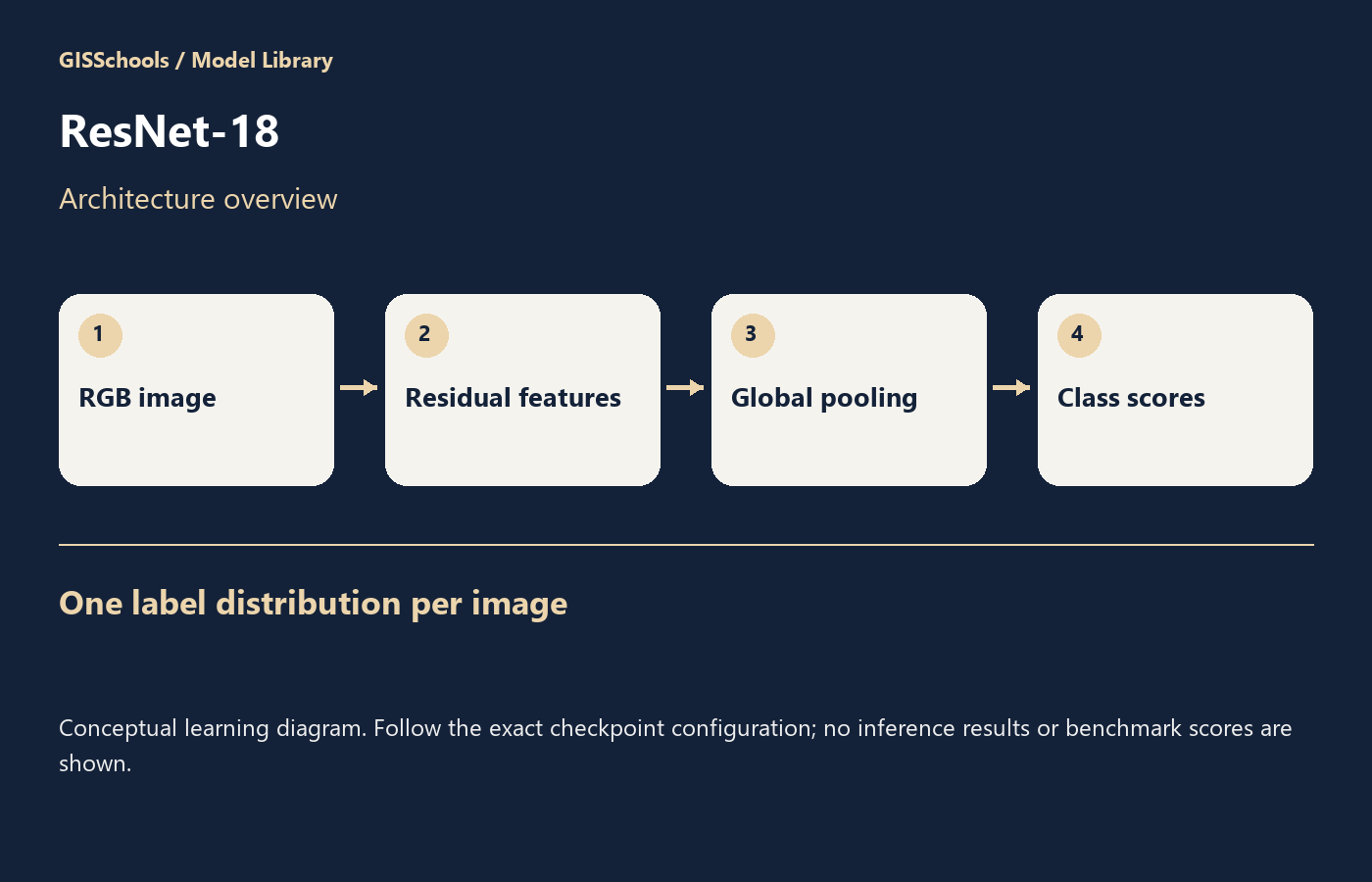
Convolutional blocks extract image features. Residual shortcuts add an earlier representation to a later one, allowing useful information to pass around a block. Pooling condenses the representation and the final layer scores whole-image classes. It does not draw object boundaries.
Typical input and output
The saved processor uses 224-pixel size with resize/crop behavior and RGB normalization. Load the packaged processor rather than substituting an arbitrary image resize. Output is a vector of ImageNet class scores for each input image.
Strengths
A compact, well-documented baseline makes classification experiments easier to debug. Residual blocks provide a useful comparison with a patch-based vision Transformer.
GIS and remote-sensing use
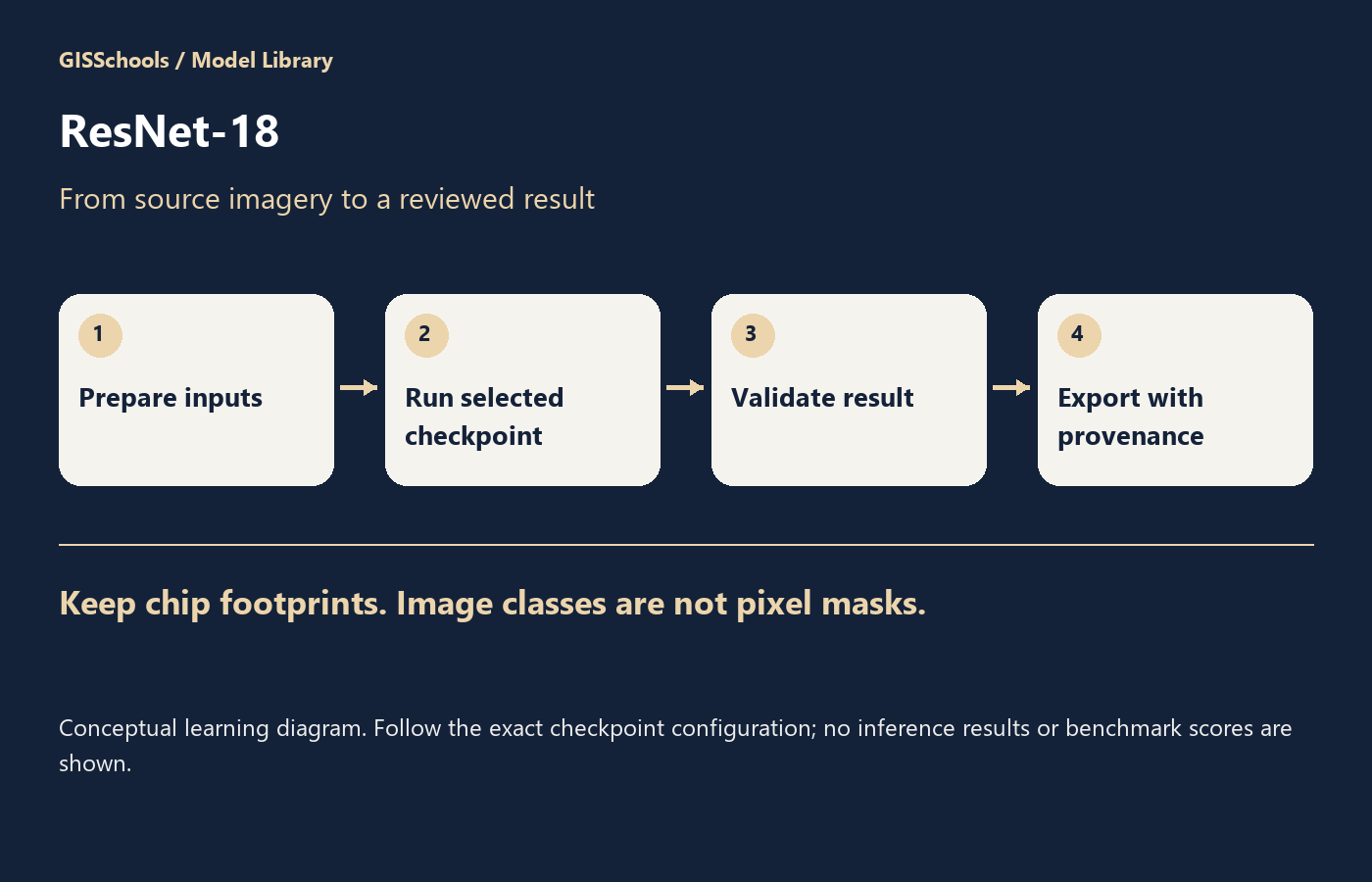
Use as a transfer-learning baseline for labeled image chips, such as scene-type screening or selecting candidate imagery for review. Replace the classification head and train with target scene labels before claiming GIS classes. Store each prediction against its chip footprint, not as a pixel mask.
Limitations
An ImageNet label is not a land-cover label. A mixed urban-and-water chip still receives whole-image scores; this model cannot show where each land-cover class occurs. It has no native multispectral input or georeferencing.
Training and fine-tuning
Begin with licensed RGB chips and a written class definition. Train a new classification head, then compare partial or full backbone fine-tuning using held-out geographic areas. Inspect ambiguous mixed scenes and class imbalance. Preserve the processor and new class mapping with the trained checkpoint.
Framework and hardware
PyTorch and Hugging Face Transformers. Extract the ZIP, then load AutoImageProcessor and AutoModelForImageClassification from the resnet18 folder. CPU can support a small functional trial; GPU training is more practical for repeated experiments. No fixed memory or speed requirement is asserted.
Files, license and download
Locally hosted ZIP contains unchanged official-namespace safetensors, configuration, processor and provider model card, plus Apache-2.0 text and provenance. The provider card explicitly declares Apache-2.0. Dataset access and imagery rights remain separate.
Local package provenance
ZIP size: 43,474,349 bytes. SHA-256: a567ff03d63e53de4bc5aa11a728edb5a64cf82976a6fa1862739d6bfc64204a. Each original weight file was checked against the provider SHA-256 before packaging. No weights were converted or retrained.
Before using a result
- Keep imagery rights, acquisition dates and preprocessing with each experiment.
- Separate locations before tiling to avoid train/test leakage.
- Inspect failures and uncertain outputs alongside the original imagery.
- Preserve coordinate transforms and verify units before exporting a GIS layer.
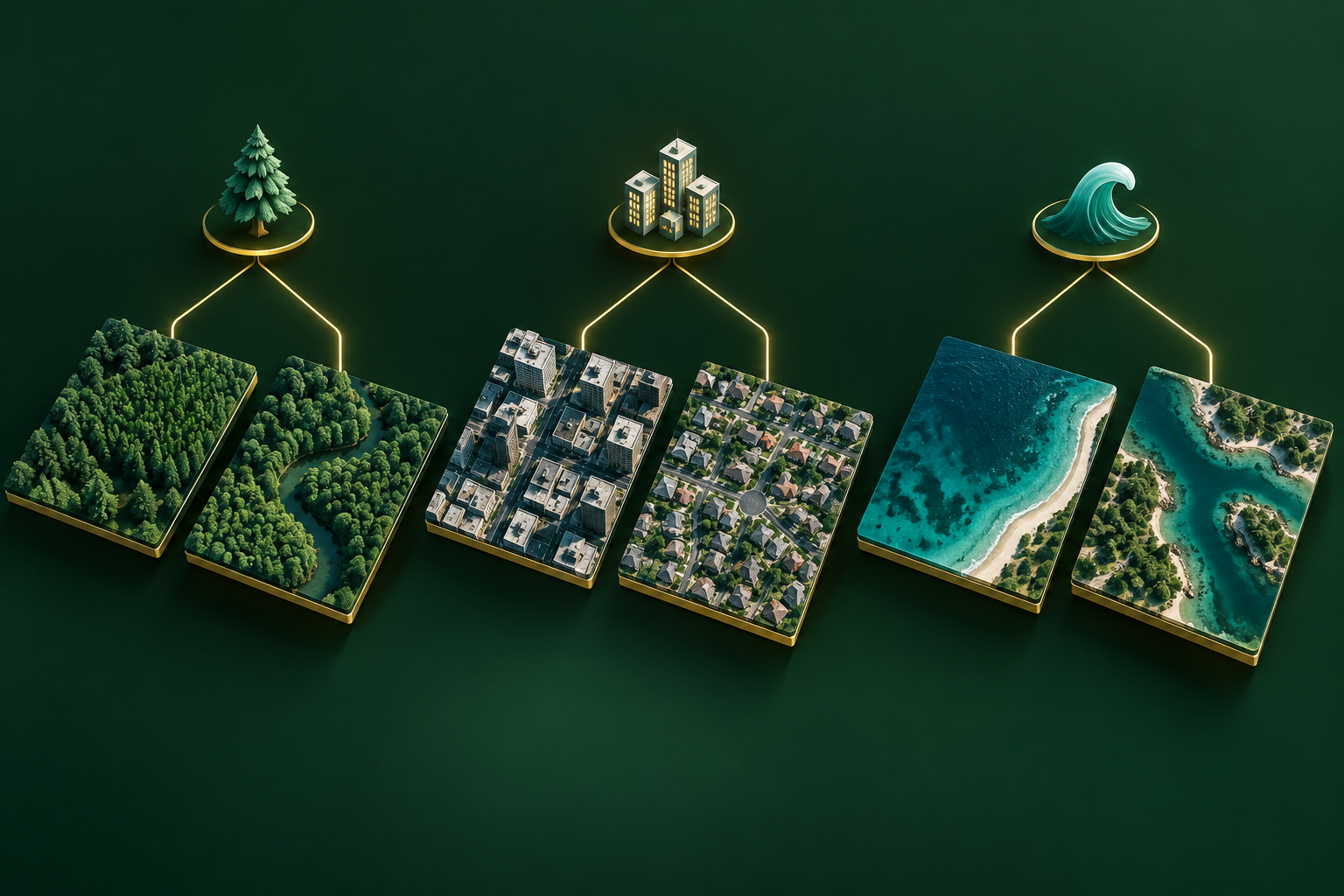
Validation status: Source provenance and website delivery are checked. GISSchools has not run model inference, training or an accuracy benchmark for this record. Feature images and gallery diagrams are explanatory illustrations, not predictions.
Official references
Examples and images
Downloads and resources
Original provider weights, model card, license and SHA-256 provenance. Extract the ZIP and follow the linked implementation instructions.
Locally hosted ZIP contains unchanged official-namespace safetensors, configuration, processor and provider model card, plus Apache-2.0 text and provenance. The provider card explicitly declares Apache-2.0. Dataset access and imagery rights remain separate.
Comments
No comments yet. Start the discussion.
Leave a reply
Your email address will not be published. Required fields are marked.