

Exact checkpoint
Original depth_anything_v2_vits.pth at provider revision 03876f8651c73a60fe4c2c48294e09fcb6838fcf. This is the relative-depth Small model, not a metric-depth or video-specific checkpoint. The unchanged original file is 99,218,434 bytes.
How it works
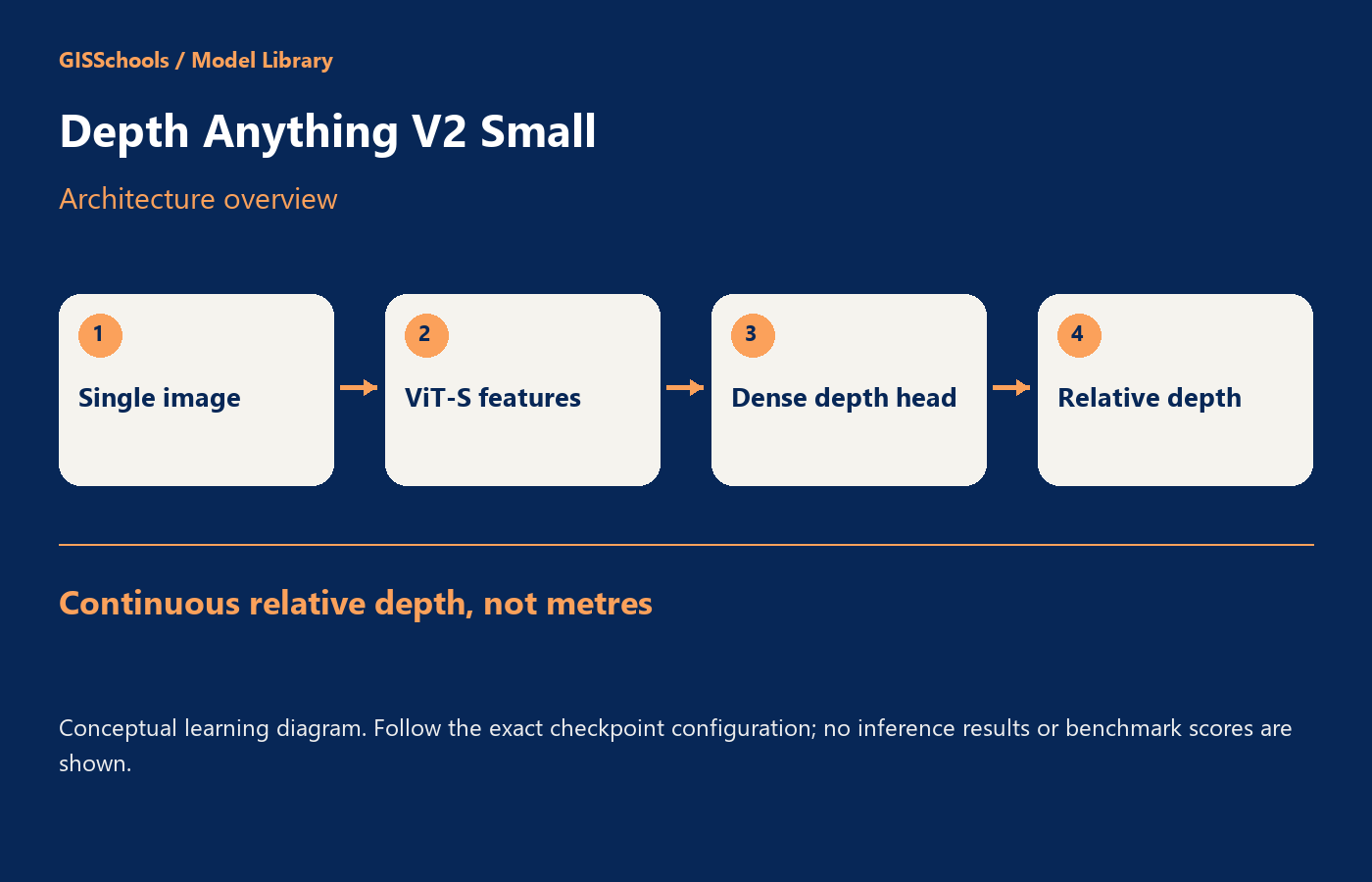
A vision Transformer extracts intermediate image features. A dense prediction head combines them into a continuous depth-like field. Relative depth encodes scene ordering and structure without establishing an absolute distance scale.
Typical input and output
The original infer_image method accepts an OpenCV image and defaults to input_size 518, with aspect-aware preprocessing and dimensions adjusted to the patch constraints. Output is resized to the source image grid. Follow the original loader to avoid RGB/BGR or interpolation mismatches.
Strengths
A compact depth model is useful for exploring visual geometry and comparing scene structure. The original implementation and exact checkpoint make preprocessing reproducible.
GIS and remote-sensing use
Use for exploratory scene interpretation or to study depth cues in street-level and oblique imagery. Do not export its values as a DEM with invented units. Metric reconstruction requires an appropriate calibrated workflow and independent measurements.
Limitations
Values from this selected relative model are not metres, terrain elevation or canopy height. Aerial nadir views differ from many perspective scenes. Reflective surfaces, distant regions and unusual viewpoints need careful review. Separate metric checkpoints must not be confused with this one.
Training and fine-tuning
For domain adaptation, pair imagery with reliable depth supervision and document whether the target is relative or metric. Match the loss and evaluation to that choice. Separate sites and cameras in validation. The main release emphasizes inference; a full new training recipe should be designed and validated instead of assuming this download is a complete trainer.
Framework and hardware
Original PyTorch Depth Anything V2 code. Extract the ZIP, copy the .pth to the repository checkpoints directory and use the Small/vits configuration. CPU, CUDA or supported alternative devices depend on the installed stack; training and high-resolution inference benefit from suitable accelerators.
Files, license and download
Locally hosted: unchanged original .pth and provider model card, with Apache-2.0 text and provenance. Only the Small checkpoint carries this permissive license; do not transfer that assumption to Base, Large or Giant weights.
Local package provenance
ZIP size: 92,103,150 bytes. SHA-256: c4542d72197ebb408c5a90a8329ff4042a54738889601b97b67481d23fd91f0b. Each original weight file was checked against the provider SHA-256 before packaging. No weights were converted or retrained.
Before using a result
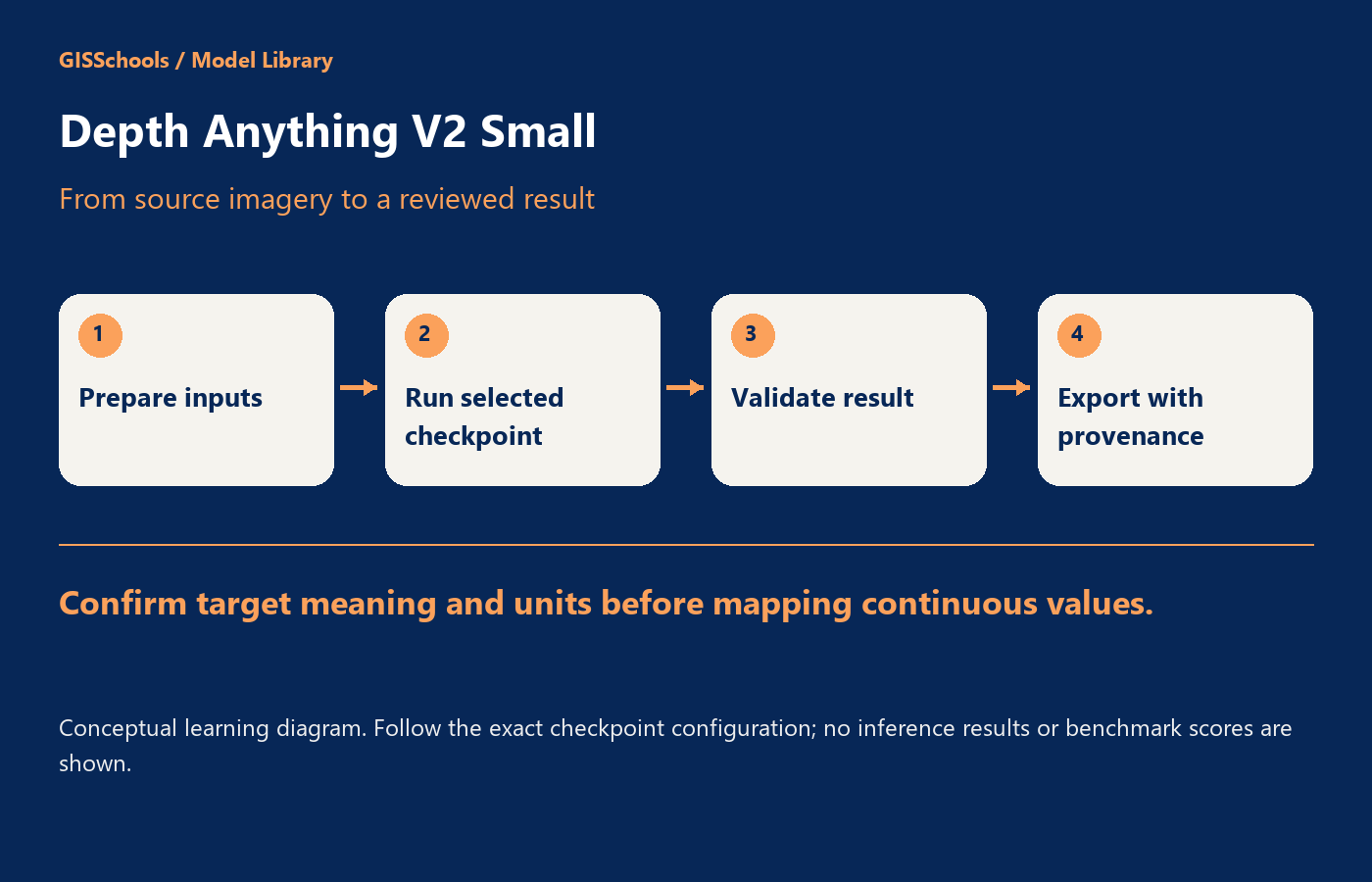
- Keep imagery rights, acquisition dates and preprocessing with each experiment.
- Separate locations before tiling to avoid train/test leakage.
- Inspect failures and uncertain outputs alongside the original imagery.
- Preserve coordinate transforms and verify units before exporting a GIS layer.
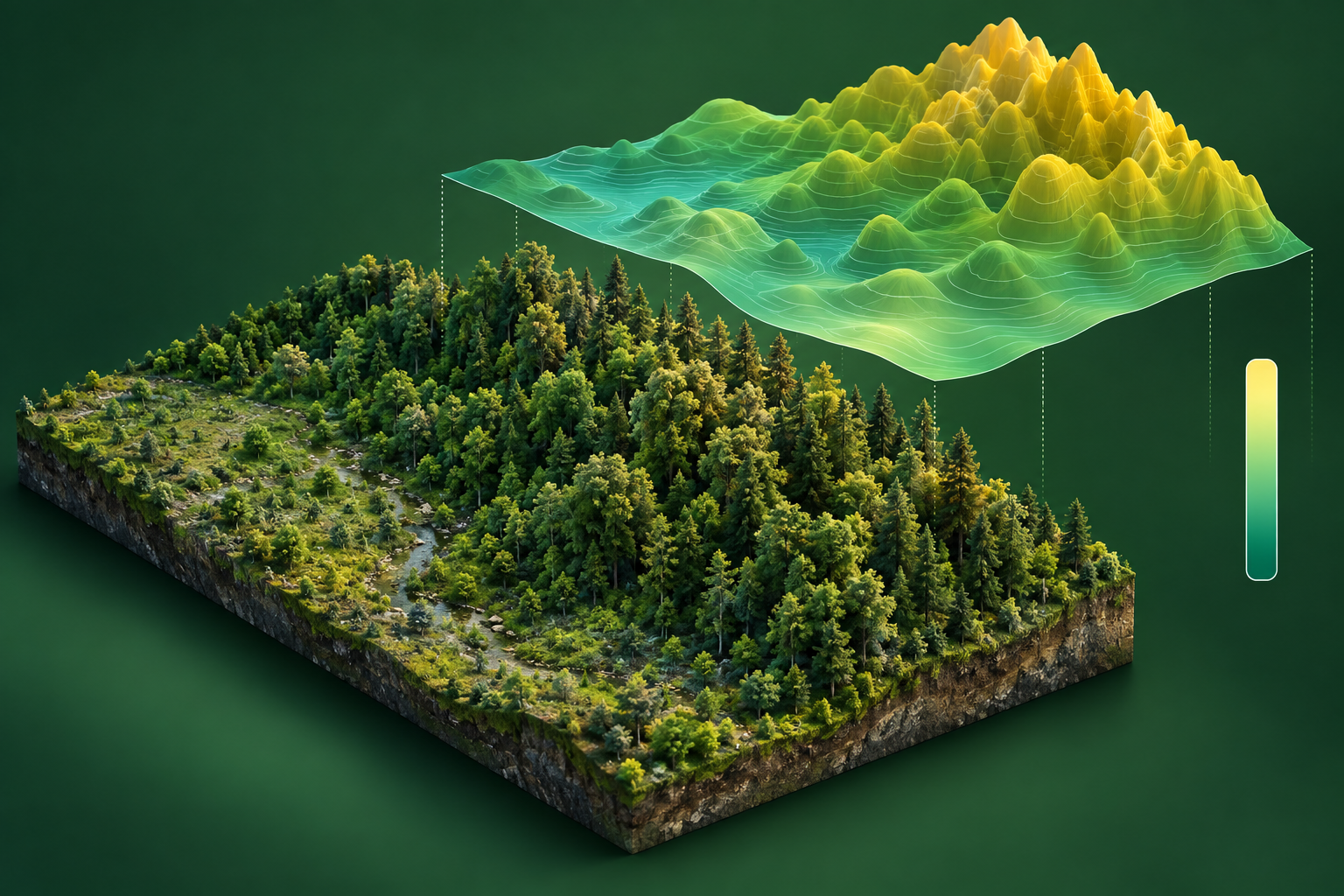
Validation status: Source provenance and website delivery are checked. GISSchools has not run model inference, training or an accuracy benchmark for this record. Feature images and gallery diagrams are explanatory illustrations, not predictions.
Official references
Examples and images
Downloads and resources
Original provider weights, model card, license and SHA-256 provenance. Extract the ZIP and follow the linked implementation instructions.
Locally hosted: unchanged original .pth and provider model card, with Apache-2.0 text and provenance. Only the Small checkpoint carries this permissive license; do not transfer that assumption to Base, Large or Giant weights.
Comments
No comments yet. Start the discussion.
Leave a reply
Your email address will not be published. Required fields are marked.